Showing posts with label Test of Honour. Show all posts

Monday, 3 January 2022

Japanese pirates: Scheltrum Miniatures' Wako

 Introduction

For some years now, I have been searching for more Sengoku-era Japanese bandits with which to populate my games of Test of Honour.  Some models are available from the usual suspects (such as Perry Miniatures, Warlord Games & Footsore Miniatures), but I want more variety.

Scheltrum are a long-established model manufacturer in Scotland.  They have a wide range of figures for some fairly unusual genres - but they really don't do the internet at all.  Eventually, I managed to track down this elusive company at last year's Carronade show in Falkirk, where they had a large stall.

I was curious about Scheltrum's Wako models - feudal Japanese pirates - and so I purchased one of the several available packs.  I thought that these would be suitable for use as generic bandits.  Read on to find out whether I was right!

First Impressions
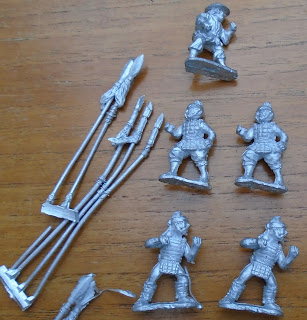
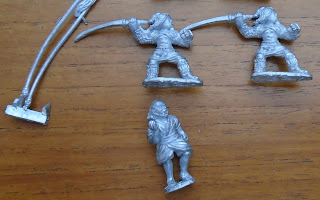
There were 8 models in the pack I had bought.  Two of these were unique and three were pairs of duplicated figures.  Six of the eight had open hands for weapons, whilst one pair of figures were moulded with exceptionally large swords.  Other than the separate weapons, the models were just a single piece.

The supplied weapons were all spears with a variety of lengths.  Some of the longer poles had attachments just below the head; I'm guessing that these were "fire lances" - primitive gunpowder weapons.

A few of the figures had noticeable amounts of flash on them, but this was easy to remove (and quite soft metal as well).

Finished Figures

It took a while to paint all my Wako.  In the end, I replaced a fair number of the weapons with spare spears and swords from another manufacturer (AW Miniatures, if I remember correctly?).  This was because I didn't wish to have my bandits armed with fire lances, even though the supplied weapons were perfectly acceptable parts in all other respects..
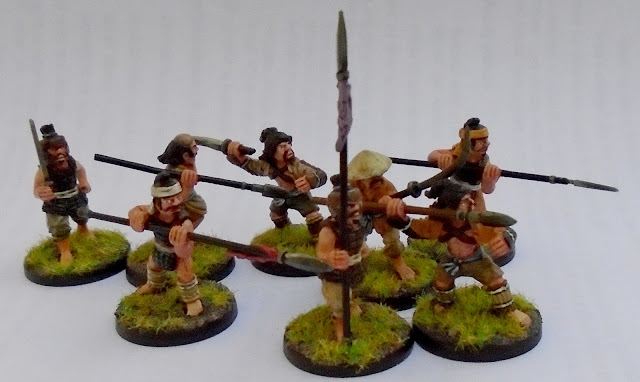
The entire set.  What a bunch of ruffians!


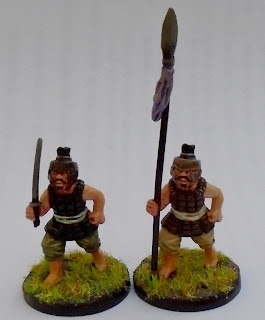
Two figures with "half helmet" (not sure how else to describe this?).  The sword (from AW Miniatures) looks a little odd, perhaps - but I didn't want to make them both into spearmen.


The pair of swordsmen from the Wako pack.  I've converted the one on the right by removing the sword and replacing it with a spear.  In my mind, these both look a bit odd, as the remaining sword is huge and the overarm spear thrust is not something I associate with Japanese/samurai fighting styles.


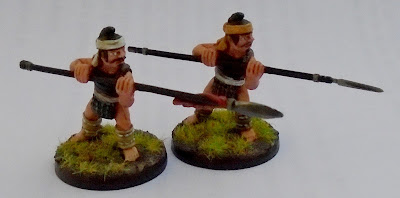
Two bandits with spears, headbands and partial armour.  Good, serviceable figures.


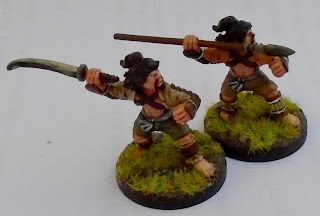
The two unique models from the pack:
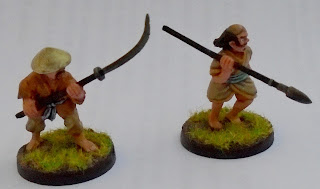
The left-hand figure - with the hat - would work fine with either a spear or (as shown) a naginata.
The right-hand figure is perhaps the most generic model in the set: there's nothing about him that makes me think of Sengoku-period Japan (maybe the hair style?).

Conclusion

There is a distinct lack of information about Scheltrum's products available!  Hopefully, this article goes some small way towards fixing that.  Note that their Wako range has several other packs as well; these have greater or lesser amounts of armour, I believe.  Indeed, one model even has a Spanish-style helmet, presumably looted from some unfortunate sailor!

The style of these models is definitely a generation or two behind the best available today.  I've already mentioned a bit of flash on the castings; as well as that the figures are anatomically a bit exaggerated (the heads & hands are big, for starters).  Add to that the soft metal and it all screams "old fashioned".

Having said that, I think they are perfectly acceptable crowd-fillers.  These models will help to bulk out the back ranks of my bandit warband and add some welcome variety to such motley crews.  I will most certainly use them in my games.

Addendum
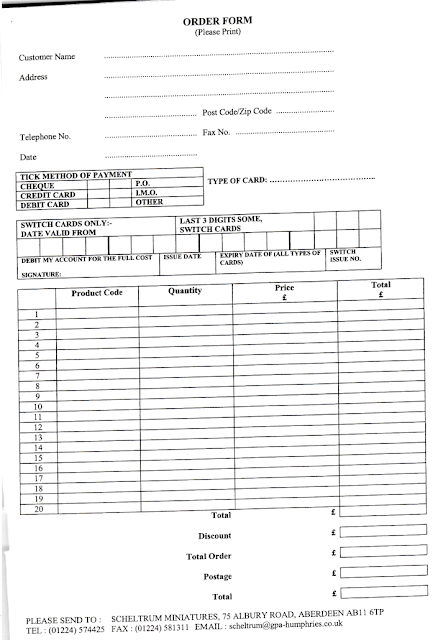
Because there seems to be some interest in contacting Scheltrum, I have scanned the part of their catalogue that has contact details.  I cannot vouch for the accuracy of any of the forms of communication printed there; all I can say is that this comes from a paper catalogue which was handed to me in person at the Carronade show in late 2021.

Note: I do know that they have (at the time of writing) no website.  There is an old website name floating around for Scheltrum, but it seems to have been abandoned for a long time.


Tuesday, 21 September 2021

Batrep: The Treasure of Toyokawa

 Introduction


In the small village of Toyokawa, in Hida province, there are rumours that a local merchant has been avoiding taxes by hiding a large part of his wealth.  The local samurai lord, Ekei of the Oda clan, has set out to investigate this and seize any treasure he can find.  In this he is joined by the ronin Tadashi, a disgraced distant cousin who is trying to regain some honour in order to be accepted back into decent society.

However, the story of hidden riches has also reached the ears of a local Sohei monastery.  The abbot has gathered a few followers and has joined (reluctantly) with a bunch of mercenary ninjas in order to search the village himself.

The Setup

This was a 4 player game of Test of Honour, with two of the players being new to the rules.  To keep it simple, each player had 18 point forces.  In practice this meant that each force had 1 major hero, 1 minor hero and a greater or lesser number of assorted followers.

There are 5 treasure counters hidden around the village.  Each of these can only be discovered by a successful test of wits.  Once revealed, 2 of the 5 tokens are false leads and are worthless.

This leaves 3 genuine treasures.  The winner is the faction which carries any two of these back over their base line, or the remaining side if all of one force are wiped out.  There is no turn limit.

The Game

As the followers on each side advanced cautiously, Tadashi raced past the shrine, intending to search the hand cart.  He was confronted by the Ninja Master and although they exchanged blows, no damage was done at first.


Meanwhile, at the other end of the village, Ekei searched the merchant's garden.  Buried under the radishes, he found a small box which clinked when he shook it.  It seemed as if the stories were true.  It was just as well for the merchant that he and his family had fled, otherwise Ekei would have had his head for this trickery!


Feeling outmatched, Tadashi ran away re-positioned strategically, but the Ninja Master pursued him anyway and cut him down.  One of the other bandits did try to aid his leader, but his attempt to leap over the rice fields to reach the fight failed spectacularly and he ended up stretched out full length in the mud.

At the same time, the Sohei Abbot ran over the bridge and cut down Tadashi's lieutenant.  This was a calamity for the ronin/bandit player!


In revenge, the Oda samurai archer drew his bow and shot at the Ninja Master.  His aim was true and the arrow struck the black-clad figure in a vital spot, sending him to his death.

Then we realised that the Oda figure had already taken all of his permitted actions for the turn and couldn't have made this play.  We reset: no arrow was shot and the Ninja Master was unharmed.  It was all a daydream.


With a dazzling display of martial prowess, the Sohei Abbot continued to rampage through the now-leaderless bandits, cutting down several and causing many others to flee.


Back in the merchant's house, Ekei carried on with his search for treasure.  It was taking too long, though - he could hear the sounds of struggle growing louder as his followers in the street outside clashed with the advancing Sohei.


While the Sohei Abbot continued to terrorise the bandit commoners, the Ninja Master decided to investigate the bullock cart.  After screwing up his face in disgust he searched through piles of dung and found ... nothing!  [In other words, he uncovered one of the "fake" treasure tokens].


Finally, after much effort, Ekei's efforts were rewarded and he found a small pouch of precious items [so that's 2 treasures.  All he has to do is run off the board and the Oda/Ronin alliance wins the game.].

However, escaping might be a problem.  Ransacking the merchant's house had taken several turns and now enemies filled the street, waiting for the Oda lord to show his face.

Ekei took the initiative and charged out, straight at the Sohei Abbot.  Such was the ferocity of his assault that the monk was driven back, step by step.  However, Ekei still couldn't risk slipping around his enemy; the gap between the abbot and the his other foes was too uncertain.


Outnumbered like this, the end was not long in coming.  As Ekei fought furiously with the Abbot, the Sohei lieutenant charged him from behind and cut him down.  There was no realistic chance that the remaining bandits or Oda spearmen could challenge the Sohei and Ninja heroes, so the game was conceded by blue/blue.  In any case, we had reached our real-world time limit and needed to pack up.

Conclusion

Well, that could have gone differently at any one of a number of points!

  • The loss of both the Ronin/bandit leaders relatively early was a terrible disaster.
  • Ekei did find 2 treasures, but took too long in doing this.  If he had just been luckier with his searches then he would have had time to escape.  Probably.
  • The Sohei Abbot was death incarnate.  He strolled along main street as if he owned the place, cutting down all who stood in his way.  Mostly peasants, mind you.
  • The Ninja Master survived a near-death experience from the Oda archer.  If this had really happened then it would certainly have changed the balance of the game considerably!
  • The Sohei drew huge numbers of Fate tokens and ended up with a lot of skill cards in play.  In contrast, the Ninjas didn't draw a single one.
...but these are all "ifs" and "might have been".  The only real question is this: did the players enjoy themselves?  I can only speak for myself: I thought it was a very entertaining evening!

Saturday, 18 September 2021

Seven Samurai

 Introduction

Seven Samurai, Kurosawa's masterpiece, has been one of my favourite films ever since I first saw it.  The story has been repeated and remade so many times that I've lost count.  Many people will recognise the plot; it has been transposed into other settings such as Western (The Magnificent Seven) and Science Fiction (Battle Beyond the Stars).

Until recently I could only dream of being one of the small band of heroes facing off against huge numbers of bandits, at least in a game.  Then, Footsore Miniatures released a pack for the Test of Honour game called "Seven Ronin".  Of course I rushed out and bought these models, but then life got in the way and it took me quite a long time to paint them.  Still, here they are, at last.

Kambei

Kambei is the leader of the seven.  He is getting on a bit, but is wise, experienced as a commander and proficient with his weapons.


Kyuzo

The taciturn Kyuzo lives only for the perfection of his swordsmanship and is idolised by some of his younger comrades.


Kikuchiro

The tall Kikuchiro has strong emotions and is perhaps a little deranged.  Initially he has some difficulty fitting in, but finds his niche as an emotional bridge between the samurai and the peasant farmers they are sworn to protect.


Katsushiro

Katsushiro is the youngest and most innocent of the group.  He's independently wealthy and has tagged along for the adventure rather than because he needs to work for food.


Heihachi

Heihachi is not the greatest warrior, but he is witty and charming.


Gorobei

A capable, mellow and observant samurai, Gorobei is also a proficient archer.


Shichiroji

Shichiroji is an old friend of Kambei's - both thought the other one dead before meeting up at the start of the story.


Conclusion

For the most part, I've let the pictures above speak for themselves.  For anyone who wishes more information on the characters, the story or the film, the internet is awash with reviews, synopses and analyses.  But seriously, if you haven't already seen the movie then why not?

On the figures: Footsore have produced some extraordinarily fine representations of the characters from the movie.  I have some concerns that the realistic-thickness swords may prove  a bit flimsy for gaming models, but apart from that these are very fine figures.

Since the original film is black & white, it's difficult to find primary sources for the colour schemes.  There are a few secondary sources (such as later collectable models and book illustrations) which depict the seven in colour, but these aren't consistent with each other.

In the end, I've chosen colours that seem plausible to me and I've tried to copy at least some of the patterning on their clothes, usually simplified a bit to fit my skill level.

OK, now I need a whole load of Japanese bandits.  And a village.  And villagers...

Sunday, 25 August 2019

Test of Honour: The Takeda

Introduction

In January this year, I showed off my Oda Clan samurai and their followers.  Since then, I've added a few figures to them, but that's not what I'm going to talk about here.  Instead, this will showcase my Takeda, my second "Clan" force for the Test of Honour game and (in my gaming world, at least) mortal enemies of the Oda.

All my Test of Honour forces have their own base colours, so that they can be more easily identified during a game.  The Oda are all done in black and white armour & insignia, though clothing and other items will vary.  My ninjas are in black (well, it's traditional), whilst my bandits & ronin are in drab browns and greens.  As you will see, the Takeda use red and yellow as their "signature" colours.

Samurai


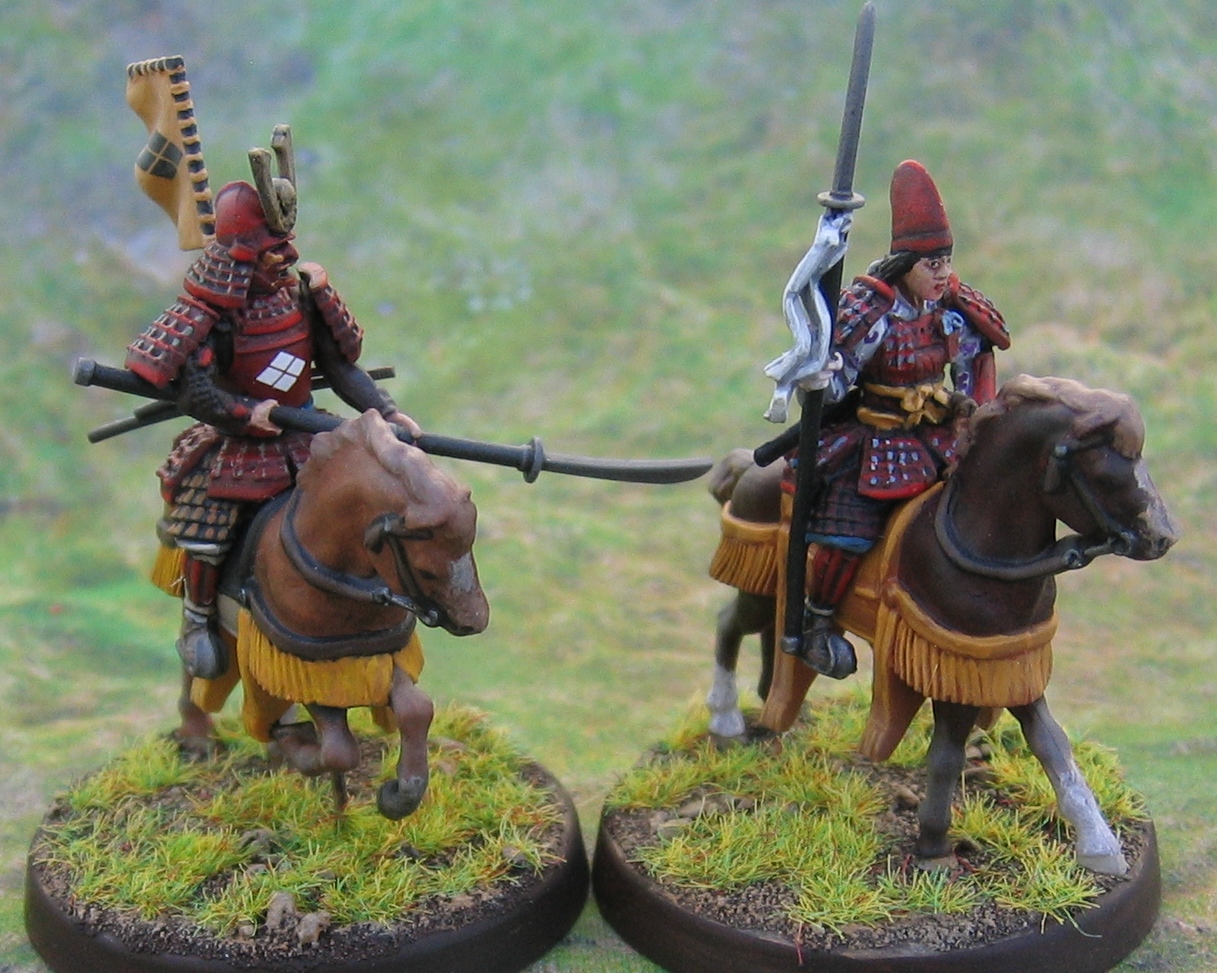
I now have a few mounted troops; these are being slowly painted up as Oda, Takeda and bandit warriors.  This pair are the widow Naoko, the red lady of the Takeda and Shigetsuna, her faithful castellan.


I've just realised that both of this pair are armed with naginatas.  The next pair (still on the painting table) have a bow and a spear - so I haven't modelled any of the Takeda horsemen with just a sword.  I guess it doesn't really matter; Test of Honour doesn't make a huge distinction between different melee weapons.


I now have 4 foot samurai for the Takeda, 2 armed with katana, one with spear and one with naginata.  Since a game only requires 1 hero and (typically) up to 2 lieutenants, this does give me a choice of appearance and weaponry.


The first 3 models from the left are all Warlord Games plastics, whilst Okitomo (at the right hand end) is from Footsore.

Ashigaru


All my spearmen for this clan are plastic models from Warlord Games.  As others have documented repeatedly, these are a real pain to assemble and are somewhat fragile when built.  Indeed, I can see that one of the spear tips is broken already...


My Takeda archers are - guess what?  More Warlord plastics...


At least the bowmen are a bit more robust than the spearmen, though just as fiddly to construct.  Note that I've modelled one of these as an ammunition carrier; he's useful as the "3rd man" in a Test of Honour group.


Now for something slightly different.  I have a group of 3 musketmen for the Takeda and these models come from Perry Miniatures.  They're single-piece castings, relatively cheap and absolutely gorgeous sculpts.


Anyone who examines the Perry range will know that infantry like this usually come in packs of 6 models.  In this case, the other 3 musket ashigaru have joined my Oda clan and therefore have black & white liveries.


Finally, here are some "special" ashigaru models.  There are 2 sergeants, one conch-blower/musician and one standard bearer.


Unsurprisingly, these are all Warlord Games plastics.  At least the plastic is a benefit for the very tall standard, as a metal flag would probably make the figure very top-heavy and liable to topple over all the time.


Conclusion

If I were starting over for this period then I think I'd probably stick with Perry Miniatures for the clan forces.  Indeed, I also like their Ninjas and they have many figures usable as bandits as well.  The Footsore figures are fairly good, but I've had some slight issues fitting 2-part models together.  While the plastics are cheap & versatile, the Warlord models are just too fiddly and fragile for me.

However one thing's for certain: I will still be expanding my Test of Honour forces for quite some time to come!

Sunday, 13 January 2019

Test of Honour: The Oda Clan

Introduction

It's been a while since I wrote an article about any of my models.  Indeed, I haven't been blogging very frequently for some months now.  At least in part, that's because much of my hobby effort has been diverted towards preparing forces with which to play Test of Honour.

For anyone who hasn't heard of this, it's a simple, fast-play game of heroic skirmishes, set in feudal Japan.  This is aimed at recreating scenes from classic films such as "Seven Samurai", rather than necessarily being historically accurate.  As such, it promises to be great fun and very much the kind of thing I enjoy!

The Oda

The Test of Honour box set put out by Warlord Games contains enough figures for 2 basic forces of 2 or 3 Samurai backed by Ashigaru (peasant) troopers.  I've painted up half of the box set with a black-and-white livery and given them "mon" (Japanese heraldic icons) that indicate they belong to the Oda family.  A few other, metal figures have been added to give a little more variety.

The Samurai


A Test of Honour force is led by 1 hero and can have up to 2 other samurai in it.  The 2 figures in the middle armed with katanas are plastic figures from the ToH starter set.  However, I wanted some variety and so there are 3 metal samurai with alternate weapons also in this band.


The metal clubman, spearman and archer all come from Footsore Miniatures.  They're a little bigger and bulkier than the Warlord plastics, but not enough to bother me.

Ashigaru


As well as the leaders, my warband includes some troopers for them to lead.  I built the 15 ashigaru in this force as follows:

  • 4 archers
  • 1 musician (conch player)
  • 1 ammunition carrier (he can be the "3rd man" in an archer group - ToH allows "units" of 3 commoners as well as single figures)
  • 1 standard bearer
  • 1 sergeant
  • 7 spearmen

The Geisha


I felt that I wanted a geisha as well, partly because they are such an iconic part of Japanese history and partly so that she could act as a spy or other scenario-specific objective.


This geisha model is from Hasslefree Miniatures, although (oddly) she's listed amongst their Modern martial artists.  Still, her costume seems traditional enough to me.  This was a refreshingly different model to paint; I enjoyed doing so very much and I'm immensely pleased with the result!

A Word on the Figures

I can't really finish this description without saying at least something about the models involved:

Warlord Games

 These are the plastics that were originally produced by the now-defunct Wargames Factory.

Advantages:
  • They're cheap!
  • They can be built into some very nice models.
Disadvantages:
  • These are the most fiddly, fragile plastic models I've ever built.  Most have 10+ separate parts (for example 2 legs, 2 body, head, 2 arms, spear, sashimono, swords) and many of these are extremely thin and delicate.  No doubt they're scaled very accurately and are in "real world" proportions, but I have grave doubts about their durability on the wargames table.
  • Matching arms to spears is something of a nightmare; not all combinations work properly and you need to use trial and error to figure it out.

Footsore Miniatures

I've only bought a few metal samurai from Footsore and cannot therefore comment on the rest of their range.  However, here are some observations on the figures I've built.

Advantages:
  • The models available cover exactly the weapons options from Test of Honour.  That's hardly surprising, since they were (I believe) made for the game, or the game was made for this range or something like that.
  • They're nicely-detailed, solid models; I'm not particularly worried about them breaking with normal use.
Disadvantages:
  • I found that several of the Footsore models didn't fit together at all well and needed quite a bit of adjustment.
  • They're a bit more expensive than the Warlord models, or other ranges such as the excellent Perry Miniatures samurai.

Conclusion


Here's the entire clan so far.  In this picture you can also see my first piece of Japanese-themed scenery (who'd have thought it - a bridge!).

I do have plans to add some arquebuses to the Oda, but these may have to take their turn.  After all, I'm also working on the red/yellow Takeda clan as well as bandit and ninja warbands.  And more scenery.  And some ronin.  And it might be nice to get some warrior monks.  Perhaps some horsemen too...